Mississippi's Missing Murders
Or: When imputing data goes wrong.

In 2025, the rate of ‘murder and non-negligent manslaughter,’ as recorded by the FBI, is projected to hit its lowest level since reliable national data began to be recorded in 1960. Conversely, the rate of homicide, as recorded in CDC mortality statistics, will likely not hit its lowest rate in 2025. Based on the first seven months of 2025, I project the homicide rate to be 4.94 per 100,000, slightly higher than the rate recorded in 2014 (4.90 per 100,000).1
A small difference, yes, but it does raise the question – why would the FBI’s recorded ‘murder’ rate differ from CDC’s ‘homicide’ rate? And, why is the CDC’s homicide rate not quite hitting its lowest rate in 65 years at the same time that the FBI’s murder rate will?
An easy answer for the first question is that homicide is a more inclusive category than murder. For example, ‘justifiable’ homicides, such as those committed in self-defense, do not get included in the final ‘murder’ statistics recorded by the FBI as they are not technically crimes.
The more complicated answer is that there has been an increasing gap between the national murder rate and homicide rate during recent years. Based on the 2025 projection of CDC mortality data, there should have been around 16,800 homicides last year. Jeff Asher recently estimated that the FBI will report around 14,000 murders in 2025. A portion of the 2,800 difference between the total number of murders and homicides could just be due to the more inclusive homicide category. After all, there are around 1,300 police-involved homicides each year that rarely are counted as murders.2 Throw in a few hundred confrontations in stand-your-ground states and you (may) have accounted for nearly half of the difference. But we are still missing something like 1,500 murders nationally if the CDC homicide statistics are to be trusted.
Of course, it is possible that the CDC’s estimates are too high. I did run across an estimate for homicides for Schuylkill County, Pennsylvania that seemed implausible a few years back; there was a discontinuous ‘jump’ in the annual homicide rate in this county where I could find no local reporting of rampant violence to match the mortality estimates.
The FBI’s Reporting/Estimation Issues
This case notwithstanding, given the data limitations for the FBI, it is more likely that we are missing a few hundred (to a few thousand) murders across the country each year. There was a well-publicized dip in agencies reporting data in 2021 due to the switch to the National Incident Based Reporting System (NIBRS). Data coverage has not fully recovered from this switch. For example, less than half of agencies in Florida reported data in 2024. Several other states have hovered at just over 50% of their agencies reporting. The figure below depicts the mean proportion of agencies reporting complete data to the FBI by state.
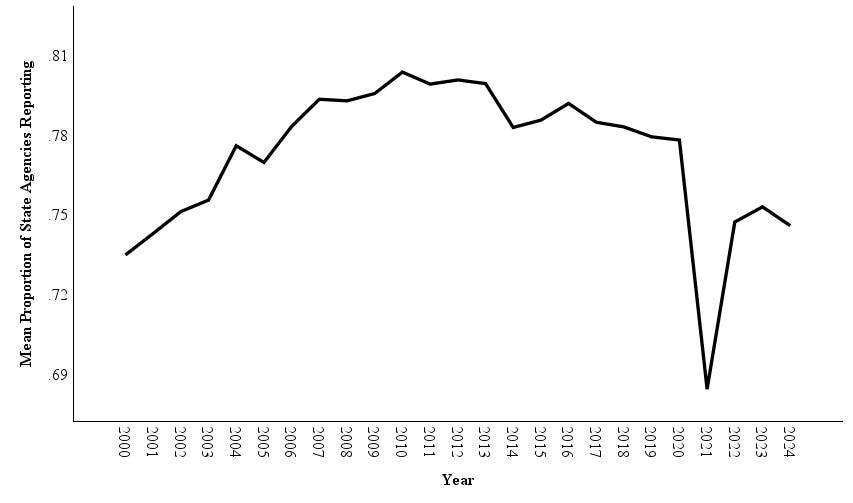
In cases where agencies fail to report crime statistics, the FBI attempts to impute data to make a final estimate for each state (and nationally). Data imputation of missing values, or making an estimate for the missing agency rather than simply recording ‘0’ offenses, can either over- or under-estimate the actual number of offenses that occurred within a given non-reporting agency. Ideally, with the right imputation technique, these misses occur both above and below the actual number of offenses in a given agency/jurisdiction; these estimate misses should “even out” to converge around the actual rate of crime overall.
However, as data reporting rates decline, these imputed estimates are less likely to be accurate. More assumptions have to be made with less data and, especially if the missing data are not “missing at random,” it gets harder to know whether there are systematic differences between agencies that do and do not report crime data.
Which may be why we are likely missing 1,500+ murders in the FBI estimates during recent years. While it is true that, during some years, states have had actually reported/recorded more murders (to the FBI) than homicides (to the CDC), what has been more more typical in recent years is a growing number more estimated homicides than murders.
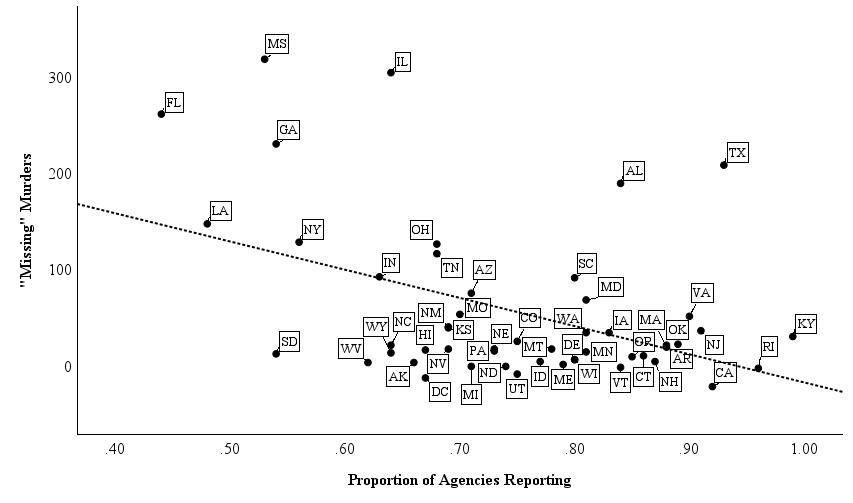
The graph below depicts the difference between the number of homicides reported by the CDC and murders estimated by the FBI in each of the 50 states and Washington DC in 2024. Higher numbers suggest more “missing” murders (fewer murders than homicides in the state between these two data sources). These “missing” murders are compared to the proportion of agencies reporting data in each state. There is a moderately strong (r = .45; R2 = .20) association, suggesting larger misses in states with fewer agencies reporting. And, unfortunately for the accuracy of the FBI’s data, the misses all seem to be in the ‘same direction’; states that have a significant number of agencies failing to report data all have a larger number of homicides than murders. In none of the states where more than 40% of agencies fail to report does the FBI appear to over-estimate the murder rate.
Mississippi’s Missing Murders
Of the states with the most “missing” murders, Mississippi tops the list. In 2024, Mississippi had 318 more estimated homicides than murders. While this only barely edges out the 304 in Illinois or the 261 in Florida, the per capita numbers are staggering. Re-examining the same data as the previous graph, but standardized by each state’s population, you can see that Mississippi’s “missing” murder rate is more than 10 per 100,000.
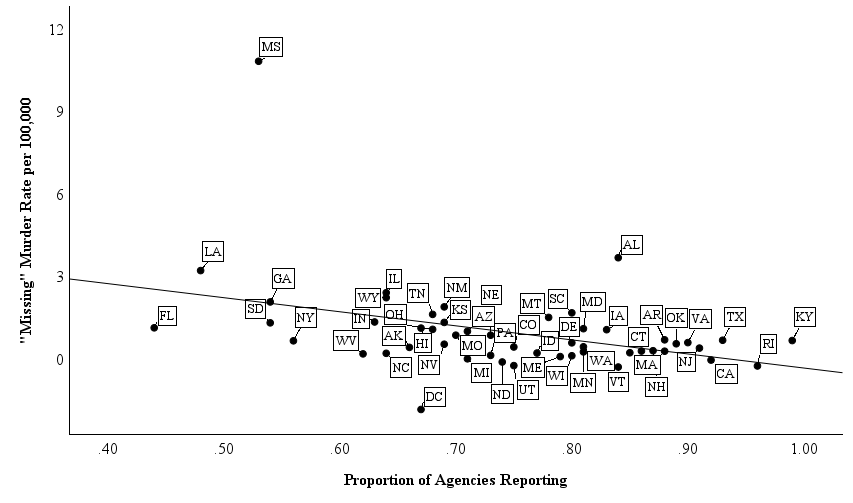
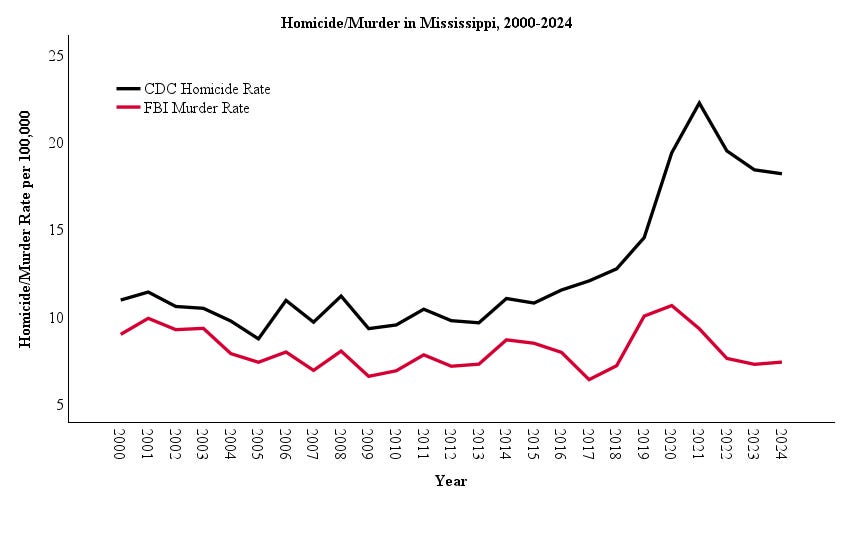
This difference between the murder and homicide rates is extraordinary. Excluding DC, Mississippi had the 8th highest state murder rate in 2024 (7.37 per 100,000); in that same year, it had the highest estimated homicide rate by a large margin (18.18 per 100,000).
As is apparent in the figure below, Mississippi had one of the most dramatic surges in homicide of any state in the country during the past decade. Between 2013 and 2021, the homicide rate in Mississippi increased by 131%; the FBI only detected a 28% increase in the murder rate during this same period.