


On April 29, 2025, Crime Wave: The American Homicide Epidemic was published. The timing, I felt, was a bit unfortunate. The manuscript had been finished for a year at that point and I had been hoping that the publication date would be close to the 2024 Presidential Election. Because the issue of crime had been hotly contested within the campaigns, I thought that a journalist could run across my newly published book about crime trends and insert it into the political debate, thereby giving me free publicity. But, alas, that did not happen.
In the end, the publication date likely would not have mattered. As it turns out, people do not go out of their way to read academic books written by unknown authors, even if they cover a timely issue and have a provocative title. Only once during the past year has a journalist reached out to me for an interview involving the book. As it turns out, he didn’t read it, but found out about the book through my posts on Substack.
Here was the news report based on that interview:
This is one of the things that I got wrong. I believed that publishing a book on homicide trends would have help bring clarity to the public debate. Instead, even in academic papers on the topic, my arguments, and the evidence that I presented, have largely been ignored. As far as impacting the public conversation, I would have been better off publishing my research on Substack.
This article is not primarily about my gripes about how much better Substack is for disseminating ideas to an interested audience than traditional book publishing. Instead, on the one year anniversary of the publication of Crime Wave, it is a good time for me to reflect on what I got right and wrong concerning the last decade of homicide trends.
What I Got Right
Now that there are several years of additional data available, I am able to assess whether my arguments still hold up now that homicide rates are declining. Many of my central claims have performed well while the broader narrative/framework (or my proposed ‘causes of causes’) needs to be revisited. Let’s begin with what I got right.
Part #1: Drugs, Alcohol, and (Maybe) Guns
My central observations, that trends in drug use, alcohol abuse, and (maybe) firearm access impacted the homicide rate, have been vindicated by the data. Within the book, I tested these associations at the state level and found evidence for each. Since writing the book, I have also documented that trends in drug overdose, alcohol consumption-related deaths, and the rate of suicides using a firearm were associated with the 2010-2022 increase in the homicide rate within the 200 largest U.S. counties.
Additionally, now that the homicide rate is declining, it appears that it is following these three trends in its descent. Below, I display the standardized (Z-score) trends in the homicide rate, alcohol-related deaths, drug overdoses, and firearm sales from 2010 to 2025.1 Over this period, these trends have been strongly associated with the national homicide rate (alcohol: r = .81; drug-overdose: r = .92; firearm purchases: r = .88).
Given the evidence that I alluded to, in addition to the relatively strong correlation (r = .88), why do I say that I was ‘maybe’ right about firearm access? The trends in firearm sales and the trends in other metrics of firearm possession (the firearm-to-non-firearm suicide ratio) have diverged since 2020. I will re-visit this incongruity in more detail in the ‘Guns’ sub-section below.
But, overall, no other explanation of recent crime trends has plausibly accounted for both the rise and fall of the homicide rate as successfully as I did in Crime Wave.
Part #2: The Limitations of an Exclusive Focus on ‘Policing’
In addition to being largely vindicated about these trends, it has also become more apparent that the ever-popular ‘lack of policing’ framing is limited in its explanatory power.
Similar to what is depicted in the figure below, I showed in Crime Wave that the homicide rate had been increasing prior to the nationwide George Floyd protests in early June of 2020. In this figure, I depict the ‘excess’ monthly homicide rate compared to the 2010-2014 baseline. By the end of May of 2020, the homicide rate had already increased by 1.77 homicides per 1,000,000 above the baseline rate; that is, the majority of the total monthly increase (65%) occurred prior to peak ‘George Floyd’ era. And, even without the nationwide protests, the homicide rate would have likely continued to increase into June and July given historical seasonal patterns.
Unlike some of the initial reports pointing to a discontinuous jump in June of 2020, a subsequent nationwide analysis of weekly homicide rates has pointed to a much earlier spike - beginning in October of 2019. This aligns more closely with my argument that the homicide spike occurred prior to the “de-policing” crisis.
Another reason that I continue to maintain my stance on the limitations of the de-policing argument is that it has been largely abandoned by its proponents as homicide rates declined. Some may obliquely imply that de-policing was the reason for the initial increase in violent crime and that the recent decline is simply a reversion to the historical mean. Yet, no one (that I am aware of) has made the affirmative case for a policing-based explanation of the homicide rate decline since 2021.
This lack of an affirmative case may be because police staffing has suffered since the pandemic and has never quite recovered. The chart below was produced by Jeff Asher, showing that most major cities have fewer officers in 2025 (per capita) than they did in 2019. It is hard to fit a broader de-policing argument with the emerging trend of fewer police corresponding with fewer murders. The 20% to 30% declines in police officers per capita in some cities is not unlike the reductions proposed by those wishing to “defund the police,” and yet, the homicide decline happened everywhere, even with fewer cops on the beat.
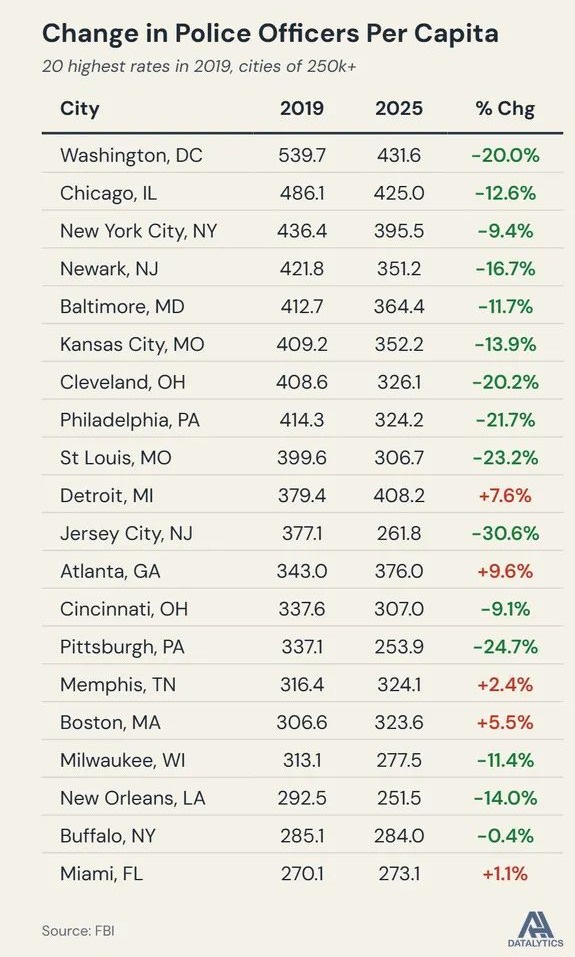
Overall, I did not argue that policing was completely irrelevant to the crime trend story, but the timing of the homicide spike and the simultaneous decline in police officers and the murder rate cuts against the centrality of the policing narrative.
What I Have More Doubts About
Part #1: Guns
I have become somewhat less convinced about whether firearm access trends are as important as I once thought. At the very least, it depends on which metric of firearm access/attainment that you look at. One of the reasons that I had initially believed in the importance of firearm access was the growing percentage of fatal assaults in which the victim was killed using a gun. In fact, there was no change in non-firearm-related homicide rate during the same era (2014-2021) that the firearm-enabled homicide rate increased by nearly 83% (see below).
Despite the increase in firearm-related homicides, the role of firearm access has been less clear during the homicide decline. As I noted in a previous article, the firearm-to-non-firearm suicide ratio has continued to increase at the same time that firearm purchases and firearm-enabled homicides have declined.
Below, I display the strong correlation between the firearm purchase rate and the firearm-to-non-firearm homicide ratio (r = .93). Conversely the firearm-to-non-firearm suicide ratio has no significant correlation with the trend in gun-facilitated homicides (r = .15).
Additionally, the firearm purchase rate per 1,000 population and the firearm-to-non-firearm suicide ratio are not correlated (r = -.01) from 1999 to 2024.2
This raises the question - are these proxies of firearm access measuring the same thing? This lack of a correlation is due, in part, to the divergent trends since 2020 - with firearm purchases declining while the percentage of suicides using a gun have increased. The incongruity of the the recent trends in firearm purchases and other metrics of gun access have caused me to be less confident that trends in firearm access are important (and that firearm purchases and firearm use in suicides are capturing the same underlying dimension).
Part #2: The Role of Distrust in the Government
Related to the incongruity of these dueling gun trends, I am also less sure about the role of distrust in government/policing in shaping firearm access. In Crime Wave, I argued that people had increasingly armed themselves during the 2010s and early 2020s in response to the perception that they could not trust the police or government to resolve disputes in a satisfactory manner. Or, relatedly, that the police/government would/could not protect them, encouraging citizens to invest in weapons for self-defense. I also pointed to the unrest during 2020 and its alignment with the single largest annual number of firearm purchases in recorded American history.
Yet, the correlations with these two metrics of firearm access differ across institutional measures of confidence.3 The firearm purchase rate shares moderate-to-strong correlations with proxies of distrust in criminal justice and policing whereas there are relatively weak to no correlation with the firearm-to-non-firearm suicide ratio and these institutional perception measures.
Additionally, I would not argue that confidence in policing, criminal justice, or the government more broadly have improved significantly and yet, firearm purchases have plummeted since 2020. There still appears to be some correlation between gun purchases and distrust of institutions, but I am less confident about this argument given the growing divergence between the two measures of firearm access. For whatever reason, trust in government is still low and people have stopped buying guys at the rate they were just a few years ago.4
What I Got Wrong
American Decline, Despair, and Substance Abuse Trends
One of the things that I did not anticipate, or at the very least needed to be more critical of, was my hypothesized ‘cause’ of substance abuse trends. When I was writing Crime Wave, I searched for an over-arching framework to place the substance abuse and homicide association into, or a proposed ‘cause of causes.’ For this, I largely adopted arguments made by Anne Case and Angus Deaton in Deaths of Despair.
Borrowing from Case and Deaton, the causal chain that I proposed went like this:
Economic distress of the working class + Declining social solidarity = Substance abuse epidemic
Substance abuse epidemic = An increase in the homicide rate
The second bullet point appears to be correct, but the first bullet is not. Or, at the very least, it offers no explanation of the recent decline in substance abuse occurring after circa 2021. There is no evidence that working class distress has been alleviated, and yet, the decline in alcohol consumption and drug abuse happened anyway. Put another way, there has been no clear improvement of the economic or social circumstances of the working class at the same time that the homicide rate has declined.
Why have drug abuse and alcohol consumption declined? I am not sure. One bleak, but plausible, explanation is that so many people died of drug overdoses during the past decade that there are now fewer people “at risk” of drug abuse and overdose. This could also lead to a shrinking market for drugs, reducing competition and stemming the tide of new entrants (drug dealers). Another argument suggests that the fentanyl supply was curtailed circa 2023, reducing the abuse of the deadliest opioids, thus curbing the fatal overdose rate.
To explain the decline in alcohol consumption, some have pointed to a broader cultural shift toward concerns with alcohol’s health impacts. I also think that the spike in inflation in 2022 could be part of the picture, although there does not appear to be a historical precedent for an inverse association between alcohol sales and inflation beyond the past few years.
Maybe all of these factors contributed to the decline in substance abuse. But it is certainly not true that material conditions improved for working class people. If anything, Americans report being more miserable now than they were prior to the beginning of the homicide epidemic (2015).
Overall, I needed to develop a more nuanced framework of substance abuse trends. Potentially, I could have examined previous criminogenic drug trends (such as the ‘crack’ epidemic of the mid-1980s and early-1990s) or the rise and fall of alcohol consumption during the 1970s and 1980s as a guide. At the time I was rushing to finish the book, it was easier for me to just copy and update the ‘deaths of despair’ narrative than actually formulate a framework that explains the rise and fall of substance abuse epidemics. Mea culpa.
What I Missed
The Rural Surge in Violence
Although I noted the uneven geographical nature of the homicide epidemic in Crime Wave, I missed the degree to which violence hit rural areas. Because the drama of previous spikes in homicide (such as those of the late 1980s and early 1990s) involved big cities, my focus was on record-breaking murder rates set in Midwestern cities like St. Louis and Milwaukee. Unbeknownst to me at the time, the spike in rural counties5 was just as large as it was in the rest of the nation. As is depicted in the figure below, the homicide rate increased by nearly 60% from 2014 to 2021 in counties with fewer than 50,000 residents.
Although it is certainly possible that rural counties faced some of the same issues with alcohol consumption and drug abuse that urban counties did, this narrative does not fit as neatly as it does in urban centers.6 Additionally, it is more difficult to assess trends in individual rural counties as there is more annual fluctuation in ‘rates’ with rare events (like homicide) in counties with small populations.
However, if I were to write the book again, I would need to at least make an attempt to provide some explanation of the surge in rural homicide. But, to be honest, I’m still not exactly sure why rural counties (especially those in the South) experienced such a large homicide rate increase.
Conclusion
I feel like I got more right than wrong in Crime Wave, which has given me (and the few that have read the book) insight into both the rise and fall of the homicide rate over the past decade.
That being said, I believe that the ‘guns’ element that I hypothesized in the book has become less clear during the homicide decline. In practical terms, firearm sales have remained predictive of the homicide trend, but firearm-enabled suicides have not during the post-2021 decline. Also, it has become apparent that I needed to develop a more comprehensive framework to account for the rise and fall of drug abuse and alcohol consumption epidemics. Going forward, I will continue to look into disaggregated trends in an attempt to make sense of these trends as well as the spike in rural homicide.
The substance abuse trends of the past decade have been quite predictive of the homicide trend. Yet, my ‘American Decline’ framing as the cause of the ‘Homicide Epidemic’ is limited, as my sense is that America, and the perceived economic/social well-being of Americans, is still in decline; yet, so is the homicide rate.
The homicide, drug, and alcohol-related deaths are all derived from the CDC. The 2025 numbers are an extrapolation of the initial months of the preliminary multiple cause data as compared to 2024. The alcohol-related deaths are only for those aged 30 to 44 as an attempt ‘age-standardize’ the trends as an older population can increase the rate of alcohol-related deaths. The firearm sales data are the the number of background checks reported to the federal government.
The firearm deaths data are derived from the CDC and the firearm purchase data are the number of background checks reported to the federal government. The ‘statistical significance’ of the correlations presented within the table is indicated using one asterisk (*) for the 95% confidence level and two asterisks (**) for the 99% confidence level.
The measures of confidence in institutions combine the column for “very little” confidence and no (“none”) confidence within the original survey results.
But maybe, they are more likely to use guns in suicides…? There might be some way of reconciling these gun trends, but it is no longer clear-cut that distrust of the police = more gun purchases/access = more firearm homicides as it was during the rise in the homicide rate.
These are the ‘micropolitan’ and ‘noncore’ counties of the CDC’s 2013 urbanization classification.
Given that the fentanyl crisis seemed to be more impactful on homicide trends than the prescription opioid abuse era, the rural homicide spike does not fit the timeline as closely as the urban spike in violence. It could be that there was some version of the illicit opioid/drug crisis in rural settings, but it was not nearly as pronounced as it was in cities during the peak homicide era (2020-2022).