

The 2026 Murder Forecast
Preliminary data suggests 2025 will set historic lows; this trend will continue in 2026

Based upon observed data through October,1 the FBI-reported murder rate in 2025 will likely be close to 4.1 per 100,000. This is lower than in 2014 (4.5 per 100,000), which was the previous record low since reliable national data began being collected in 1960.
Despite hitting a 65-year low in 2025, the homicide rate will drop even more in 2026. My forecast for a further decline mixes elements of quantitative and qualitative approaches and is not an ‘econometric’ estimation. Instead, I (largely) base this forecast on observations I made in Crime Wave concerning the unique characteristics of homicide trends over the past decade. Overall, I project the murder rate to decline by between 3% and 12.5% in 2026, likely falling by around 8%.
One note for these projections - I am making some judgement calls about the “baseline” for homicide offending/victimization prior to the ‘homicide epidemic.’ For both teenage offending/victimization and the overall homicide rate, I am assuming that there is a lower baseline than previous lows recorded in 2014. For Black victimization and firearm-enabled homicides, I think that the 2014 baseline is near where these metrics should stabalize in the near future. I explain some of my rationalizations below.
Reasons for Lower Homicide Rates in 2026
1) Continuity With 2025
While it is difficult to know when the current decline will stop, there is a certain momentum of national crime trends; if a decline is still occurring in December, there is no reason to believe that this trend will stop in January simply because it is a “new year.” For this reason alone, we could tentatively project that the homicide trend will continue to decline into early 2026.
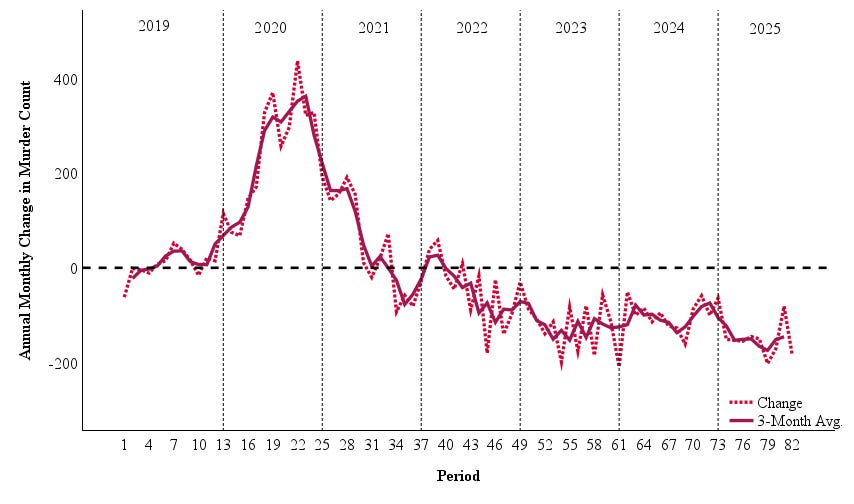
When examining annual change in the homicide count by month in the Real-Time Crime Index, there has been an accelerating decline in the murder trend during 2025. The three month average this past summer (June, July, & August) was the largest year-over-year decline (-174.3 monthly, -523 total) over this period (2019-2025). There was a slight rebound moving into Fall (August, September, & October), but there was still a three-month average of 145 fewer murders per month as compared to this time in 2024.
If we project a linear (regression) trend through the end of next year, there should be 3.8% fewer murders in 2026 than 2025. This monthly projection suggests that by January of 2027, the murder trend may stop declining.
2) Fewer Teenage Murder Victims
Conversely, trends in youth (15-19) homicide suggest a larger drop in 2026. During the fentanyl crisis, teen murder deaths (and offending) have closely followed drug overdose trends. As is apparent in the figure below, there is a strong association (r = .98) between the rate of homicide death among 15-to-19 year olds and the overall drug overdose death rate from 2014 through 2025.2
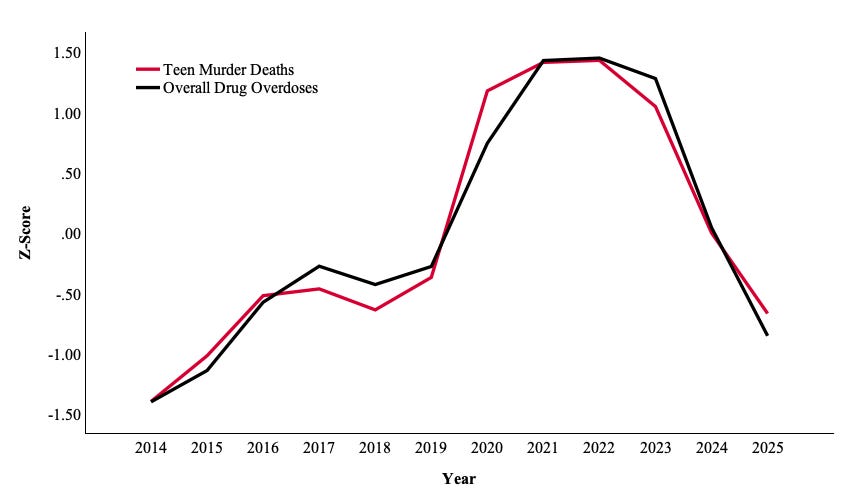
Drug overdoses, used here as a proxy measure of drug market activity, are believed to impact youth homicide involvement through disputes and competition surrounding drug sales. Although not nearly as dramatic as the spike in youth involvement in homicide during the early 1990s, expanding illicit drug markets seem draw in young drug dealers and incite gang competition. Now that drug deaths are plummeting, there are fewer illicit drug transactions and presumably less underground market activity.
The estimated youth (15-19) homicide victimization rate for 2025 will still be nearly 24% higher than in 2014. That is, teen involvement in murder is still elevated above the beginning of the fentanyl epidemic. As the drug epidemic continues to wane, so should teen homicides.
Teen homicide victimization should fall to at least 2014 levels over the next few years, if not lower. Prior to the fentanyl epidemic, there was a strong association between teen (15-19) homicide victimization and the teen birth rate (r = .87). As I have highlighted previously, teenage arrests for other crimes have largely followed the teen fertility trend, which is a proxy measure of risk-taking and unstructured time spent with peers. Youth homicide trends should (partially) re-converge with other teenage offending patterns as drug markets continue to wane.
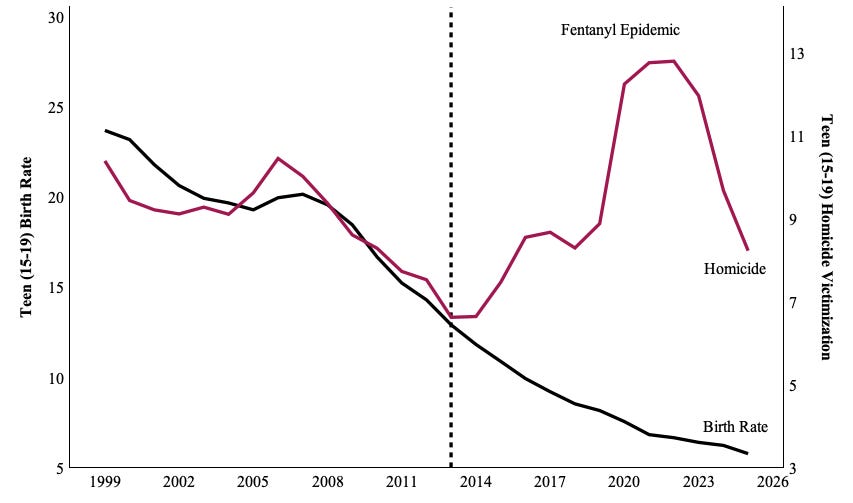
My projection for 2026? Teenage homicide victimization (and offending) will decline further. The youth victimization rate in 2026 may not be quite as low as in 2013 or 2014, but a double-digit decline in victimization among youth (10-20%) should be expected as drug overdose rates continue to plummet.
3) The Overall Murder Rate is Still “Too High”
Teen trends are also illustrative of broader dynamics with murder rates overall. Just like teen victimization “should” be lower if it had followed other historical trends prior to the fentanyl epidemic, the overall murder rate is also elevated beyond what would be expected.
Since 2014, the murder rate has increased (and then, decreased) in near lock-step with drug, alcohol, and firearm sales trends. Drug overdose death rates have been declining for the past three years and plummeting for the past two. Alcohol sales appeared to have peaked in 2021 and declined thereafter, with alcohol-related deaths among middle-aged men is following suit. Firearm sales last month appear to be the lowest in any November since 2014.
With these trends in free fall, the murder rate should converge once again with overall crime trends. The crime rate (for offenses other than murder) declined by nearly 28% between 2014 and 2024; the homicide rate was still 12% higher at the end of 2024 than in 2014. A little “back of the napkin” math would suggest that the murder rate would currently be 3.24 homicides per 100,000 if it had kept pace with other offenses. That is about 21% lower than the projected record-low rate in 2025.3
This provides some indication of how much further the homicide rate may drop in the near future. To make a specific prediction for 2026, I will look to recent trends in the robbery-to-murder ratio. In the years prior (1960-2013) to the recent homicide epidemic, the correlation between these two offenses was quite strong (r = .96). I expect these trends to partially re-converge now that the drug/alcohol/gun-driven homicide epidemic is ending.
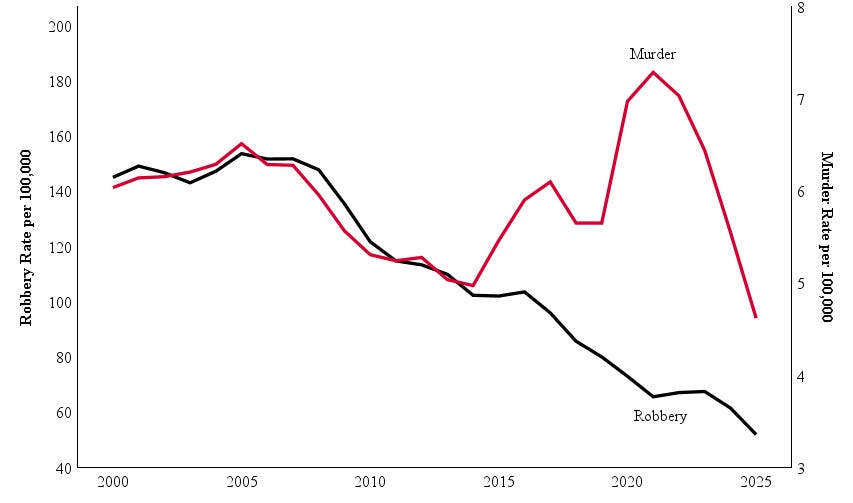
Between 1960 and 2013, the mean robbery-to-murder ratio was 23.25. From 2014 to 2021, this ratio declined every year. Since 2021, there has been a slow, but steady, increase (a mean of 0.775). This is reflected as the projected robbery-to-murder ratio for 2026 in the figure below.
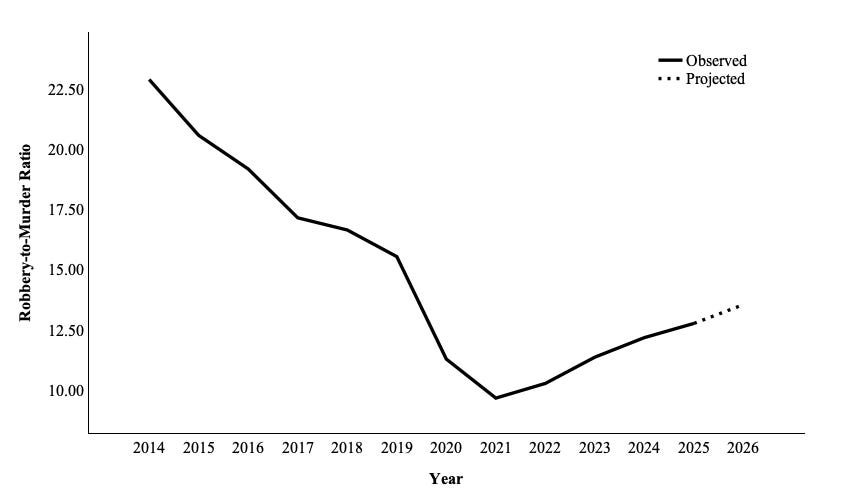
If the robbery rate remains near 2025 levels in 2026, the best estimate for the murder rate in 2026 is 3.77 per 100,000, based on the projected increase in the robbery-to-murder ratio based on the past four years. This represents an 8.5% lower rate than that projected in 2025. Of course, it is possible that the robbery rate declines in 2026 or that the robbery-to-murder ratio does not increase at the same pace as it has over the past few years, causing there to be some uncertainty about this estimate. Yet, given some other trends, this is probably close to where the murder rate will be in 2026.
An 8.5% decline in the murder rate is historically large, yet smaller than the proportional declines of 2023 (9.2%), 2024 (14.8%), and what I have estimated for 2025 (18.6%). Why would the declining trend in murder decelerate in 2026? A few other features of the homicide epidemic have nearly returned to their historical baseline, suggesting that further declines will not be as steep as during the past three years.
4) Black Homicide Victimization is (Slightly) Higher Than Expected
For example, preliminary data from the CDC suggests that Black homicide victimization declined year-over-year by 19.5% in the first five months (January-May) of 2025. This is steeper than what I estimate for the 2025 decline overall (18.6%). Also, if we harmonize the bridged-race and single-race data,4 the Black homicide victimization rate will be the lowest in modern history in 2025 (18.37 projected in 2025 vs. 18.5 in 2014).
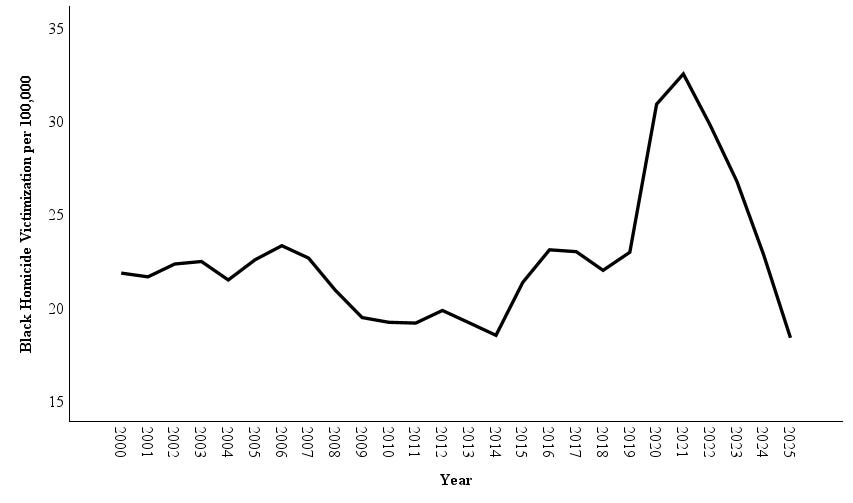
The Black homicide victimization rate and the Black-to-White victimization ratio (displayed below)5 are relevant in discussing murder trends as a growing racial disparity was a key feature of the homicide epidemic. The timeline of this growing disparity, much like the increase in teen victimization, closely aligns with the beginning of the fentanyl epidemic. Now that racial disparities are nearing pre-homicide epidemic baseline, it is likely we are likely nearing the floor on this metric.
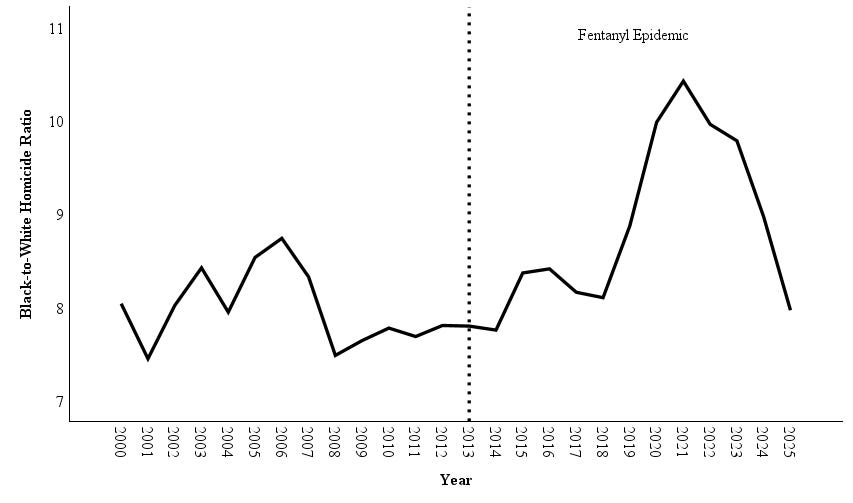
In 2025, this metric is projected to be 7.97, only 2.7% higher than the 2014 baseline (7.76). It is possible that the “floor” could be slightly lower (such as the 7.49 in 2008), but the Black homicide victimization rate would not be expected to plunge much lower based on this historical precident. White victimization may decline again, as it did in 2025 (9.4% projected), which would may lead us to conclude that there will be a larger Black homicide decline than the implied 2.7%. However, the (non-Hispanic) White victimization rate may be the lowest ever recorded already in 2025, so there is no strong (historical) basis to project a large overall homicide decline in 2026 on this metric.
5) Gun Homicides Are Elevated Above the Pre-Epidemic Baseline
Another characteristic of the homicide epidemic was that it was almost entirely perpetrated with firearms. Non-firearm-involved homicides declined almost coninually throughout the past decade. The surge in violence from 2015 to 2021 was nearly entirely due to homicides using a firearm. Below, I display the percentage of homicides in which a firearm served as the murder weapon.
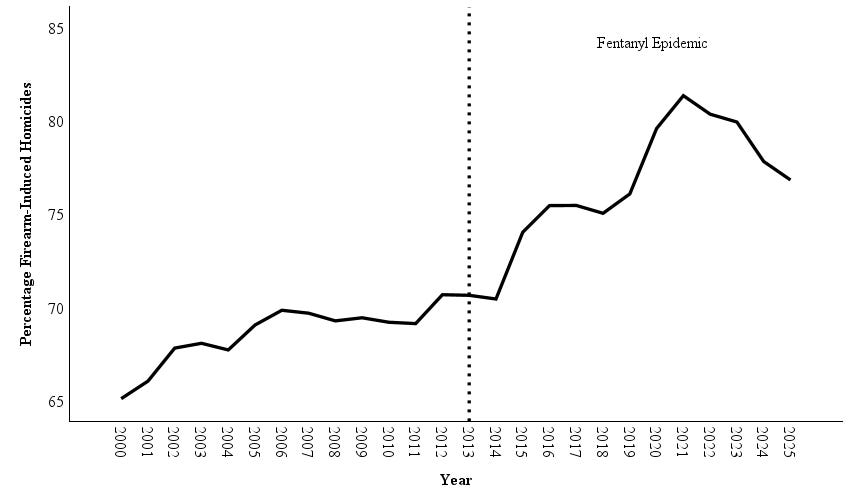
In 2025, the percentage of total homicides perpetrated using a firearm (76.8%) is still more than six percentage points above the 2014 baseline (70.5%). At first glance, this would imply a significant decline to return to pre-fentanyl epidemic levels. However, there was a nearly five percentage point increase from 2000 (65.1%) to 2014 (70.5%). This suggests that there has been a secular trend upward in the percentage of homicides using a firearm during the 21st Century, which may have occurred (to some degree) regardless of homicide epidemic-related pressures. Accordingly, I am unsure whether we will return to the ~70% baseline in the near future.6
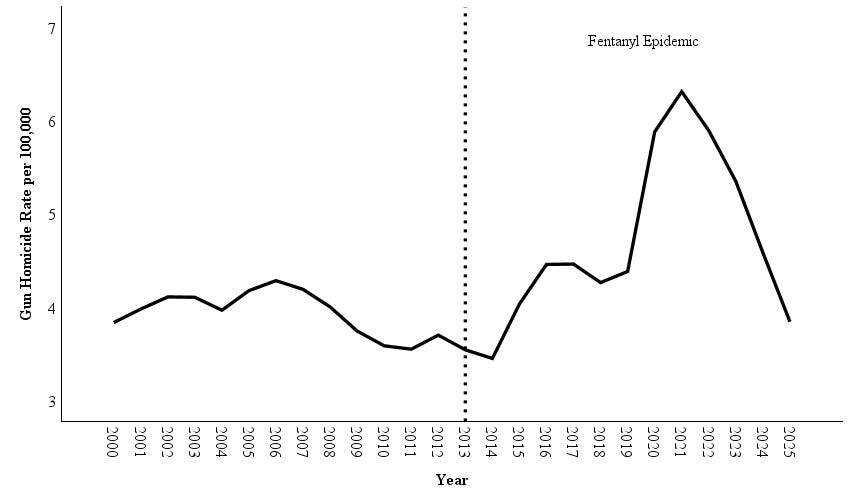
Instead, if we just examine trends in the firearm-induced homicide rate, there appears to be less of an implied declined in the near future. Based on CDC mortality data, the firearm homicide rate is projected to be 3.85 per 100,000 in 2025, which is about 11.6% higher than 2014 (3.45). Yet, a 0.4 decline (to return to this baseline) would imply only about an 8% decline in the overall CDC homicide victimization rate in 2026. Note that this is quite close to the estimated proportional decline implied by the robbery-to-murder ratio (8.5%).
Possible Upward Pressures on Crime
It is also possible that there are factors that could place upward pressures on the homicide rate in 2026. One factor in particular could reduce the margin of the homicide rate decline.
The Looming Recession
People are pessimistic about current economic conditions. Outside of data-center expansion to support the growing “artificial intelligence” industry, the U.S. economy is probably already in a recession. An economic downturn for the average person, coupled with ‘sticky’ consumer inflation, could portend more property-based offenses.
Why is probably won’t matter - Inflation and economic turmoil do not seem to ‘pack the same punch’ on crime trends as they did in the 1970s and 1980s. In fact, the 2022 spike in inflation corresponded with an overall decline in the homicide rate. Fewer people carry cash, anti-theft measures are embedded within many items of value, and online shopping has replaced a considerable share of of retail purchases, reducing the opportunity to commit in-person offenses. An economic calamity in 2026 could halt the steep decline in property crimes, but probably not enough to impact the expected downward murder trajectory next year.
Final Projection
Based on all five metrics considered, the homicide rate should decline in 2026. However, the range of this decline could vary widely based on these metrics. Although not a mathematically derived confidence interval, I estimate that the FBI-reported murder rate in 2026 should fall somewhere between 3.6 and 3.99 per 100,000. Smaller declines are implied by a modest change in the projected Black homicide victimization rate and the month-to-month linear projection. Moderate-sized declines are implied by the projections based on the overall crime rate (robbery), youth homicide trends, and firearm-enabled homicides. Overall, I expect the 2026 decline to be smaller than those recorded in 2023, 2024, and 2025, but still fairly substantial by historical standards.
Through October of 2025, data presented in the Real-Time Crime Index suggests a 19.8% reduction in the murder rate from during the past year. On average, the homicide rate among the population represented in the index is about 52% higher than the national rate. Based upon an annualized rate, the homicide rate would be predicted to be 4.12 per 100,000. However, there is some uncertainty in this projection as this is based on both an extrapolation from January through October to the rest of the year (2025) and a calculation of the mean difference between the Real-Time Crime Index murder rate and the national murder rate reported by the FBI from 2018 to 2024.
The 2025 projections for youth (15-19) homicide rate victimization and drug overdose deaths are based on the initial months of preliminary data in relation to the January and February (and March for drug overdose deaths) of 2025. Arrest statistics suggest a remarkably similar year-over-year trajectory in youth homicide offending as these trends in victimization.
The offense rate per capita for aggravated assault, robbery, burglary, larceny-theft, and motor vehicle theft was used to calculated the overall crime decline.
The non-Hispanic Black single-race homicide rate data (2018-2025) suggests about a 4% higher rate than the bridged-race data (1999-2020) in overlapping years. The single-race data are harmonized with the bridged-race standard by multiplying the homicide rate in recent years (2021-2025) by .96.
This is the ratio of the Black homicide victimization rate (harmonized to bridged-race standard) to the White homicide victimization rate per 100,000 population.
And, even though firearm sales are declining, there is no such decline in other firearm possession metrics, such as the firearm-to-non-firearm suicide ratio.